



Share

“Wild Shelter” is an internal name. It started as an inside joke, yet it perfectly captured the situation of uncertainty we all felt at that moment
Text: Iuliia Surkova
Illustrations: Maryna Kizilova, photo credit EEF, partner organisations
Fight, flight, freeze – three classic stress responses identified by psychologists worldwide.
“But during the war, Ukrainians came up with a fourth one,” said Olga. “It’s ‘help!’”
Olga Moloko has lived this reaction firsthand. For her and her colleagues, ‘help’ was not just a word but a lifeline during the endless months of war. She remembers February 24, 2022, now sitting beneath a yellow-and-blue painting that echoed the Ukrainian flag, sunlight pouring into a bright Kyiv office. Beyond the windows of the old city center, life surged on as the workday began.
Today, Olga heads the Humanitarian Aid and Recovery Cluster at East Europe Foundation. A cluster that grew out of emergency rescue and aid programs for Ukrainians launched in the first days of the invasion.
“Tens of thousands of people were fleeing the front lines,” said Olga. “Rockets were flying across every region of the country. No one knew how long this would last.”
“In the first days of the war, thousands of people spent days on the road,” said Tetyana Mazur, Head of Project Management Office (PMO) at East Europe Foundation. “We wanted to do everything we could to help. To give people a little comfort: a place where they could sleep on clean sheets, wash clothes, rest, and breathe a sigh of relief. We grabbed onto everything we could. That’s how it all began.”
Back then, the Foundation’s team had no idea that their frantic efforts to create makeshift shelters would blossom into a sweeping humanitarian mission that would reach almost every corner of the country. There was no room for hesitation – only action.
“Everyone was under stress back then,” said Tetyana. “No one was thinking in terms of grand strategies; it was a state of emergency. We transported trucks of humanitarian aid, provided medicines, food, and psychological support. We coordinated, raised funds, and distributed aid.”
Four years into the war, the need for humanitarian aid remains as urgent as ever. But now, the Foundation’s team delivers it with hard-earned expertise, swift precision, and unceasing empathy.
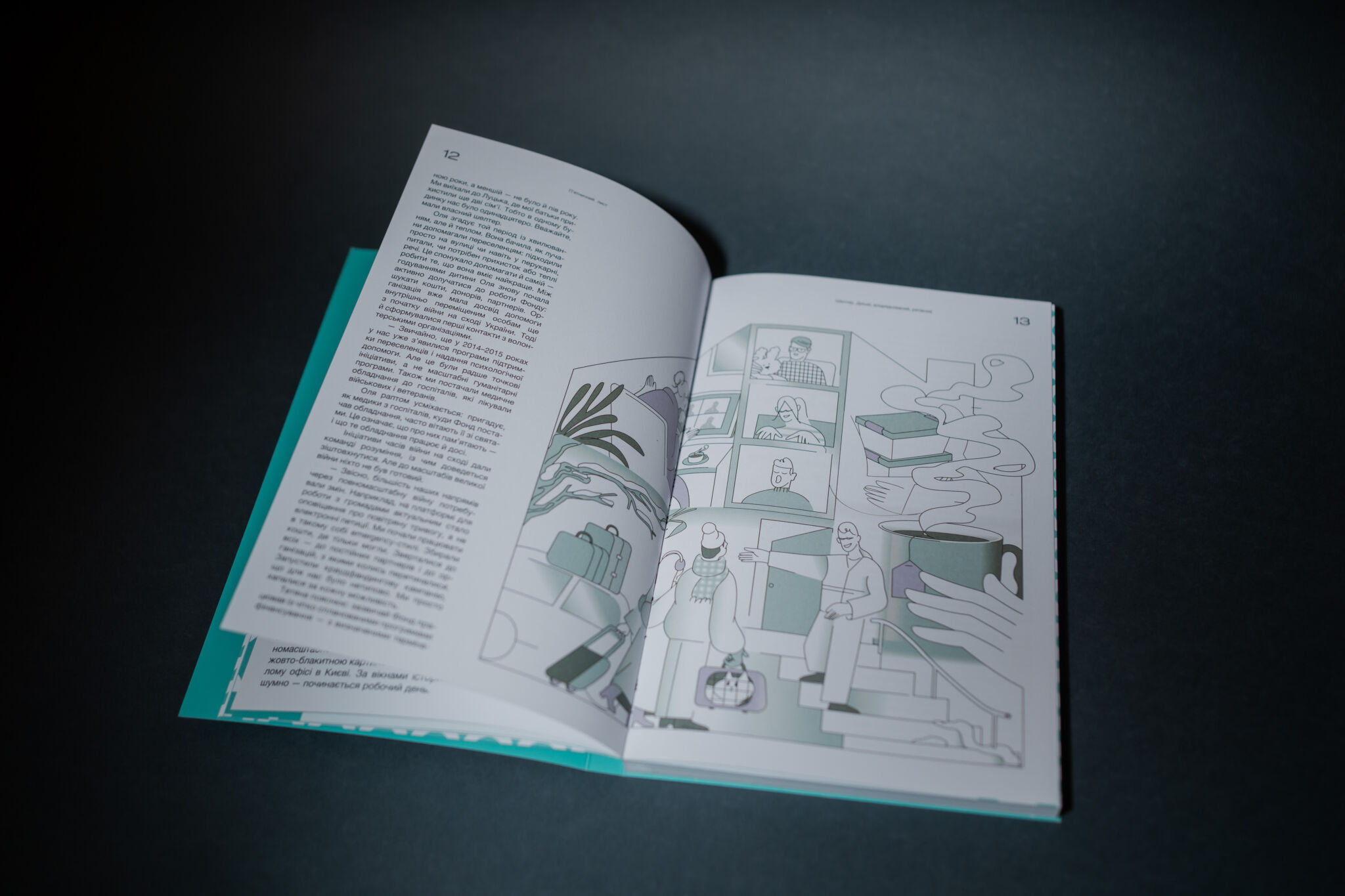
Olha remembers the beginning of 2022 in vivid detail – and not just because of the invasion. She wasn’t working at the time, having taken maternity leave, but she would occasionally see alarming messages in her work chat groups. Everyone around her was talking about what no one wanted to believe: a major war was coming to Ukraine.
“When missiles started flying toward Kyiv, my oldest child was three and a half years old, and my youngest wasn’t even six months old,” says Olia. “We left for Lutsk, where my parents were sheltering two other families. So, there were eleven of us in one house. You could say we had our own shelter.”
Olia looks back on that time with both anxiety and warmth. She watched as Lutsk locals reached out to the displaced, whether on the street or in hair salons, offering shelter or warm clothing. Their kindness moved her to action, prompting her to return to what she did best. Between caring for her children, Olia threw herself back into the Foundation’s work: searching for funds, donors, and partners. The organization’s roots in helping displaced people stretched back to the early days of the war in eastern Ukraine, when their first contacts with volunteer organizations were established.
“Of course, as early as 2014–2015, we already had programs to support displaced persons and provide psychological assistance,” said Olga. “But those were more like isolated initiatives rather than large-scale humanitarian programs. We also supplied medical equipment to hospitals treating military personnel and veterans.”
A sudden smile lights up Olia’s face as she remembers the hospital staff who still send her holiday greetings from places where the Foundation delivered equipment. Their messages remind her that they are not forgotten, and that the equipment continues to serve its purpose.
The team’s experience during the war in the east offered a glimpse of the challenges ahead. Yet nothing could have prepared them for the overwhelming reality of a full-scale invasion.
“Most of our areas of focus required changes due to the full-scale war. For example, on the community engagement platform, reporting air raid alerts became a priority, rather than collecting electronic petitions,” said Olga. “We started working in a sort of emergency mode. We raised funds wherever we could. We reached out to everyone – to our regular partners and to organizations we had crossed paths with in the past. We launched a crowdfunding campaign, which was unusual for us. We simply seized every opportunity.”
Tetyana shares that the Foundation once thrived on carefully planned funding programs, complete with strict timelines, clear goals, and detailed reports. After February 24, everything changed. They had to become flexible, adapting to chaos and uncertainty. Amid the uncertainty, this new, “wartime” style of work felt a bit chaotic for everyone. Thus, the program for transit shelters for refugees, called “Shelter,” acquired an unofficial nickname “Wild” (because it emerged spontaneously, almost overnight, because at that time there was still a lack of understanding of how to work with humanitarian projects, and because rules had to be implemented and tested on the fly).
Tetyana was there from the very beginning of the Shelter Project. She confides that as she helped Ukrainians who had lost everything, the project ended up saving her, too.
“Being able to work, to be useful, to feel that we’re actually making a difference – that gave me the strength to get through the first days of the war. And it became the motivation to stay in the country, not to leave, to be close to my family,” said Tetyana. “It was the right decision. I got a new program and a strong team, and they were very supportive. So, of course, the project had an impact on all of us and on the Foundation as a whole.”
Many people from the Foundation joined the humanitarian efforts. Partner organizations that had previously collaborated with the team also responded to the call: “Who can help, and in what way?”
Friends of the Foundation, both long-time collaborators and new supporters, responded immediately, reflecting the organization’s strong reputation at the time. In those first chaotic days of war, the Foundation’s rapid organization and outreach became a vital lifeline for partners, donors, and grantees.
They joined in purchasing kettles, slow cookers, and washing machines; organized the delivery of medicines, food, and clothing; and set up logistics – doing countless vital tasks simultaneously.
“The Shelter Project began when we started awarding grants to partner organizations that were helping people who had been on the road for three to five days,” said Tetyana. “So that a person fleeing the war could stop, sleep in a clean bed, eat a hot meal, and feel safe.”
Tetyana recalls that shelters sometimes sprang up in the most unlikely places. One memory stands out: a medieval church in Shumsk, Ternopil region, where, despite the war, a sense of peace lingered.
In the summer of 2022, only months after the Russian full-scale invasion to Ukraine began, East Europe Foundation established partnerships with leading international donors. With support from France and Denmark, and a new partnership with the UN by June, the Foundation unlocked doors to broader aid and faced a wave of new challenges.
The Foundation began searching for organizations across Ukraine to support communities affected by the war. 350 applications were submitted for a competition in which only 20 winners could be selected.
“These were mostly de-occupied communities or those that had suffered greatly during the first months of the war,” said Olia. “Every application simply screamed of some urgent need. It was an extremely difficult decision.”
During the competition, she and her colleagues conducted dozens of interviews with the finalist organizations. Each day, they had five or six video calls, each one unveiling raw, unfiltered stories of human resilience.
“We could see through the screen just how much these communities’ lives had been turned upside down and how desperately they wanted to help their people,” says Olha. “I remember an organization from the Kharkiv region: their village head had been killed, some people remained under occupation, while others managed to leave. And a woman from a local organization, who had previously worked on parks and playgrounds, began to look after the community residents. She submitted an application, took care of the displaced people, and eventually, their community received funding for humanitarian aid.”
By autumn 2022, as the shock of war faded into daily reality, the Foundation moved from urgent action to a more thoughtful, structured approach in humanitarian work. What began as a simple transit shelter program, Shelter soon blossomed into a cornerstone of our mission.
Most of the Foundation’s staff involved in the initiative were able to return to Kyiv that fall. With renewed energy, the initiative took off. But as we scaled up, we also had to tackle very minor, yet no less important, issues. Like the story with the plastic containers, Olia recalls:
“This might sound strange, but we had a very long back-and-forth with a partner regarding the standard set of non-food items we were distributing in frontline communities. The kits included pots, bedding, household goods… We asked them to add food containers. Because in the frontline communities of the Kharkiv region, there were (and still are) many abandoned homes, and mice had proliferated, eating everything they could. People received food kits, but had nowhere to store them. So, the local organization that received a grant from us under the program requested to supply such containers. We explained to the donor that this was a real local need. And we managed to give people what they really needed.”
What seemed like a minor detail turned out to be deeply meaningful. It proved that even large organizations could truly hear the voices of those they serve. Soon, requests for shovels and farming tools followed, echoing the needs of frontline communities.
“The Russians took people’s shovels and pitchforks – everything that could be used to dig trenches. In short, they looted buildings, taking everything. People were left with a patch of land but without a single tool,” says Olia.
To deliver these simple yet essential items, such as shovels or containers, EEF often had to modify and streamline complex bureaucratic procedures, adapting the rules of the game. Shelter was no longer just a support system for partners. It became a catalyst for our own transformation, teaching us how to truly run humanitarian programs.
Tetyana agrees: while supporting hundreds of partners, the Foundation itself was transformed and strengthened. In helping others, Shelter also rescued the Foundation, giving the team purpose during those tense early months and proving to international partners that Ukrainian organizations could thrive even in wartime.
“Humanitarian programs helped us all stay engaged. During the first two months of the full-scale invasion, we worked nonstop just to stay afloat,” said Tetyana. “And by the third month, we were already tackling major programs. We were implementing 300+ grants simultaneously and achieved 96% completion! When we started, we thought that even 70% would be a great result. So, this exceeded all expectations.”
Now, everyone who worked in the Shelter Project sees how it boosted the Foundation’s reputation and broadened what we could achieve. Yet, as Olia reflects on the past four years, she admits that none of this was on anyone’s mind at the time.
“Shelter” happened completely naturally. We simply couldn’t have acted any other way or taken on something else,” said Tetiana. “It seemed that, aside from providing aid, there were simply no other options. And we went down this path. I think it was the right one.”
The book “Friday Letter” is available by this link (in Ukrainian)