



Share

Text: Olena Livitska
Photos: Danylo Pavlov
Early June 2023. Kherson, freed last fall, is underwater. The Russians destroyed the dam at the Kakhovka Hydroelectric Power Plant, causing the city and almost a hundred other towns to be flooded. Thousands of people are escaping the water and the disaster. Others rushed to help them. Meanwhile, the Russians keep shelling. But that does not stop those who want to help.
A line of cars carrying boats and supplies needed by people at the center of the disaster stretched along the road to Kherson from dawn on the first day after the dam was destroyed.

Among these cars are some from the Kyiv region. Driving one is businessman Oleh Dibrova. As always, his Fox Terrier, Plaia, sits quietly beside him in the passenger seat of his small Honda. Oleh is leading this volunteer mission to Kherson, organized by a group that just completed training at the State Emergency Service center in Obolon, Kyiv, where they learned rescue skills and how to help as much as possible.
The All-Ukrainian Public Center “Volunteer” took on the task of organizing the training; Oleh and his friends have been involved since its founding in 1997, and he serves as chairman of the supervisory board and project coordinator.
East Europe Foundation responded to the call and undertook to finance the initiative as part of the Spilnodiia Program, which it implemented in partnership with the Ukrainian Independent Center for Political Research and the NGO “Together Against Corruption” with funding from the European Union. The State Emergency Service of Ukraine gladly agreed to this cooperation, as they understood its significance better than anyone else.
We must deal with this
As soon as Russia’s full-scale invasion of Ukraine began in February 2022, Russian forces occupied the Kakhovka Hydroelectric Power Plant, a Ukrainian hydroelectric facility on the Dnipro River. In October of that year, it became known that the dam and power plant units in the Kherson region had been mined. If detonated, the water would quickly engulf more than 80 settlements, threatening the lives and health of hundreds of thousands of people.
The explosion occurred at 2:50 a.m. on June 6, 2023, releasing 18 cubic kilometers of water over the next three to four days. This war crime caused a massive environmental disaster. Under international law, destroying dams is prohibited, even if they are military facilities. But the Russians are ignoring international law in their war against Ukraine.

In the days that followed, evacuation of people and pets continued in the disaster zone. For a long time, communities had no access to clean water. People from across the country and around the world helped locals clear debris and deal with the aftermath of the flooding.
The blowing up of the Kakhovka HPP dam is not just a story about ecocide and its consequences. It is also a story about social solidarity. Those were days when the meaning, role, and significance of volunteering in Ukraine were clearer than ever.
Among the thousands who rushed to help were those brought together by one of the first volunteer organizations in independent Ukraine – the Volunteer Public Organization. Not because they set out to be at the epicenter of the disaster, but because, for nearly 30 years, they have promoted and taught volunteerism.
The people of “Volunteer” are never indifferent when free help is needed. That was the case then as well, says Dmytro Doroshok, deputy chairman of the board of the “Volunteer” center.
In the spring of 2022, as soon as the Armed Forces liberated the Kyiv region, countless Ukrainians rushed to clear debris, clean up, and rebuild villages and cities after the destruction.
“It was a call to action, an impulse: everyone just came and tried to do something,” said Dmytro. “At that time, instead of clearing or dismantling debris, rescuers often had to shoo away people who were putting themselves in danger by acting incorrectly. There were so many people that we realized we had to figure this out. It’s good they were active and ready, but we needed to train everyone.”
At that time, he says, East Europe Foundation decided to support the “Volunteer” center and included them in its large-scale Cooperation Project, launched with support from the European Union. The Foundation had already collaborated with the State Emergency Service, and “Volunteer” had a similar experience. So, the pieces fell into place.
Dmytro became a manager, and Oleh went to study. Both had been brought together by volunteering in their youth. At first, Oleh Dibrova was one of the participants in the scout camps organized by Dmytro; the following year, he was already an instructor. Later, they traveled together to Germany to gain volunteer experience, wrote projects and implemented them, and developed the organization. And although each went their separate ways in adult life, joint projects brought the friends back together from time to time.
The people at “Volunteer” never turn a blind eye when help is needed
The war caught both of them in the Kyiv region. At the invasion, Dibrova was in the Bucha district, and Doroshok was in Kyiv. They made sure their families were safe while they got to work. Dmytro reorganized the center’s operations and helped people fleeing cities and villages where fighting continued. Oleh joined the volunteers and prepared to repel the Russian attack on his native Kyiv region. On March 27, he signed a contract to serve and underwent rescue training during breaks between shifts. He was amazed and heartened by the people around him.
They trained in small groups of 10-15 people. Over two weeks, each group learned about mine safety, rescue and search operations, and how the State Emergency Service operates. They taught how to handle unknown objects and what first aid and psychological support should look like when a person is in shock from an explosion, death nearby, or anxiety.
“We trained about 300 volunteers,” says Oleh Dibrova. “Maybe it’s a bit less intense than what professional rescuers do, but these are people who will definitely understand how to help. They’re all completely different – in age and social status. For example, Denys, who traveled with me to Kherson, was barely 18. The oldest was a man who is now opening a volunteer museum; he’s over 60. These are people with values. It’s a pleasure to work with them and just meet them.”
We started in January 2023 and finished the project that summer. By the time of the tragedy at the Kakhovka Hydroelectric Power Plant, some volunteers had completed their training, while others were still in progress.
Dibrova
Oleh is 45. He has spent most of his life working with cars. He sold them for official brands and brought them to market, handling everything related. For a time, he, an engineer by training, even ran a small gallery business.
His grandfather and father were in the military. Oleh grew up in an ordinary family: he wasn’t raised to be a soldier from childhood, but they taught him to make decisions by example. Oleh sometimes recalls the story of his surname, Dibrova: his grandfather was once registered in the Russian style – they said a soldier in the USSR could not be named Dibrova! Only Dibrov would do (resembling a Russian name)! But when Oleh was born, his father restored the family surname. That’s why Oleh is Dibrova again. He attended a Ukrainian school in Kyiv (“a bit of a dissident one”). He went to scout camps, studied at the Kyiv Polytechnic Institute, got married, and has two sons. He currently serves in an air defense unit in the Kyiv Oblast.

Oleh was stunned when, in February 2022, the Russians approached his native Bucha district near Kyiv. On the first day, he grabbed a hunting rifle and joined the local territorial defense, which wasn’t even called that then. They waited for the Russians from the north and took turns on watch.
No matter what Oleh did in life, he periodically returned to social projects and volunteering, which he had been involved in since his student days. The people from “Volunteer,” he says, are the closest to him, even during the war. In 2022, he felt it: his friends were by his side. Together, they organized a crossing to the other side of the Irpin River when the bridge was blown up to stop the Russian advance on Kyiv. They helped people evacuate and cleared debris at missile strike sites. Work was in full swing until the Kyiv region was liberated. During that period, Oleh realized people rushing to volunteer needed “help to help” to prevent the crowd from getting in their own way. That’s when they created the project for volunteer rescuers.
Water in the chandeliers
The people of Kherson welcomed the volunteers and hosted them in their apartments. Since then, Oleh has been friends with Roman Bezrodnyi, who was coordinating one of the humanitarian centers. Before the war, Roman ran a business making sails. Oleh is also passionate about yachts. The men bonded over shared values and interests. They can talk for hours, not just about the war.
Roman’s hub was in the center of Kherson, where the people from “Volunteer” set up shop. They gathered clean water, food, boats, motors, gasoline, and rescue equipment from all over. For several days, they sorted, packed, and loaded supplies. Two crews worked constantly on the Inhulets River, ferrying people by boat or delivering bread to flooded streets where people sat on rooftops or high ground. Meanwhile, people in Kherson kept calling the hub to donate items like boats or to ask for help.
The water receded after a few days. Operations were then organized to receive requests and provide targeted assistance. They received boats, repaired them, gave them to other rescuers, or used them to deliver bread or water.
Eventually, Oleh began traveling to Kherson every two weeks. They took requests again and cleared out flooded homes, including a kindergarten in the Korabel neighborhood. During the disaster, water completely filled his basement and rose half a meter into the first floor. When it receded, it left behind hardened mud, a sea of rotten children’s furniture, mattresses, and other items typically stored in basements.
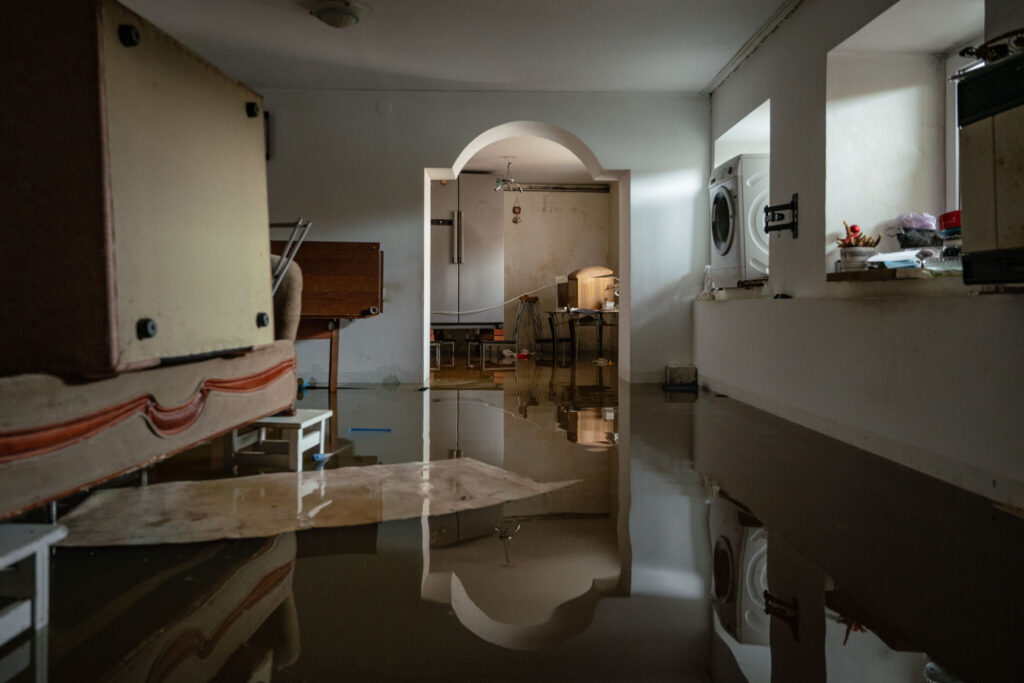
“Water still remains in the chandeliers near the ceiling,” said Oleh. “There’s no light; the generator is running. There’s this small, old children’s furniture. Old, funny, just like from our childhood. But at the same time, everything is so heavy and stinky. We couldn’t stay there for more than a few minutes.”
The city looked like the apocalypse, he says. When the flood came, it carried not just water but a mixture of sand and clay. Then everything dried out and cracked. Beneath that layer of mud were yards, lawns, and sidewalks.
“We broke up the crusted mud, carried out the ruined belongings, and listened to terrifying stories,” said Oleh. “Those were all ordinary people. It felt like walking into a grandmother’s house, seeing neighbors, or going to the store. Everyone was exactly like that. Some were beautiful, some weren’t – crooked, cross-eyed, kind, mean – absolutely ordinary people. But their stories were striking. In the middle of the conversation, the woman we visited said she had spent 60 days in the basement. She passed on information about Russian positions to us. There she met her friend, an agronomist who had maps showing the Russians’ locations. The woman returned home, where her frail mother was waiting. Her mother said, “My dear, thank God you’re out,” and then died the next day.”
People who survived the occupation are different, he is convinced. The experience remains with them as a constant theme throughout their lives. Since then, Oleh often wonders what he would have been like. Today, he has resumed his studies and is writing a research paper on the formation of cohesion in de-occupied communities.
After some time, Oleh Dibrova and Roman Bezrodnyi came up with the idea of continuing to help these communities. While working after the dam breach, they noticed how difficult it was for people to wash clothes. So, they began setting up mobile laundries: two washing machines, a pump, and a large tank of clean water. They delivered them in a trailer upon request.
Later, they drafted a project and received funding from East Europe Foundation and Switzerland. There was no longer an urgent need to transport water with the washing machines, but displaced people heading to villages still needed them. Thus, they opened 12 laundries in the Velyka Oleksandrivka community in the Kherson region and in two communities in the Mykolaiv region.
A long and good life
Every time he returned from Kherson, Oleh tried not to think about the consequences of the enemy’s actions. He is often asked to speak on this topic, but refuses.
“It’s hard for me to talk about it. They aren’t human, neither then, nor now,” he said. “The blowing up of the Kakhovka Hydroelectric Power Plant dam is truly terrifying. You walk through the city – it is empty and devastated. I knew Kherson differently. But letting these thoughts consume me is also their victory. As my wife says, ‘I hate you because I know that I am capable of hating you.’ These feelings aren’t typical of us, yet they want us to think about them.”
In Kherson, a girl of about seven got into the boat with Oleh. Khristina. Skinny, small, with big frightened eyes. She was silent and clutched a crumpled, bloodstained bag to her chest. No one touched the child. They moved her into the boat and passed others along. While waiting to cross the Inhulets River, Oleh spent a lot of time with her and got her to talk.
Her words have always come to mind whenever those days are mentioned. “I know why animals live shorter lives than we do,” the girl in the boat said. “They’re born, just like people, good and joyful, and live that way their whole lives, doing good and living it out quickly. But people start the same way and then forget about it. They need much more time to do the good they were meant to do in this world.”
“I thought about that a lot back then,” says Oleh. “Later, it turned out that in that little bag, she had been carrying a dead kitten and a barely alive puppy the whole way. Fortunately, we nursed the puppy back to health. Later, I came back and brought her a little kitten.”
***
If we recall how volunteering began in Ukraine, Dmytro Doroshok, a historian, would speak of another form of community service: Ukrainian “toloka”. The ancient tradition of gathering as a community to build a house for someone, mix clay, or work the fields. This has been in our mentality and blood since ancient times.
With the emergence of independent Ukraine, volunteering and civic engagement became its foundation. When people rallied to help and united, key events unfolded – Maidan protests, revolutions, changes, and turning points.
“How did the country’s resilience manifest at the start of the war? In the fact that people didn’t need to be told what to do. This decentralization saved us. A country’s resilience is measured by the people who care about it,” says Dmytro. This is what they sought to teach society when they first established the Volunteer Civil Society Center.
That spring training session led by the rescuers and East Europe Foundation was very timely, as Oleh now reflects. They taught people not just to help, but to manage their emotions. Not to panic, but to pull themselves together and plan their actions clearly.
Since then, Oleh has been not only in Kherson but also, for example, at the rubble of “Okhmatdyt” – a children’s hospital in Kyiv that the Russians deliberately targeted with missiles in July 2024.
He is certain: in every crisis that needs helping hands (and there are many such crises everywhere right now), there are those who were trained in Obolon. Or people like them. They are all decent and good people. Because volunteering is a filter for such people. A filter for goodness.
This story is a part of the book “Friday Letter.” You can read it in English at the link.