



Share
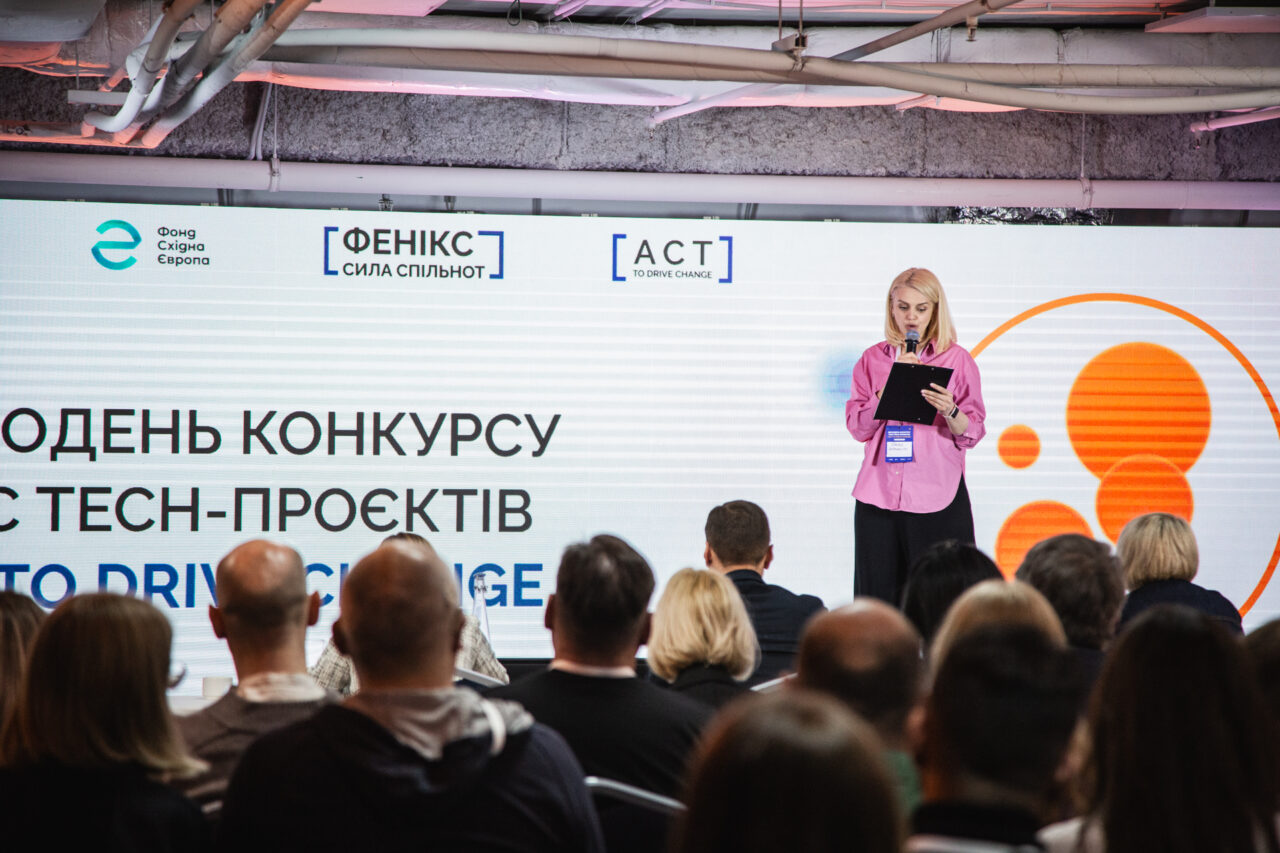
On March 17, Kyiv hosted the Demo Day of the Act to Drive Change civic tech competition. During the event, 16 Ukrainian civil society organisations presented their digital solutions aimed at community development and strengthening interaction between society and the state.
The Demo Day was held within the framework of “Phoenix: The Power of Communities” Project implemented by East Europe Foundation with the financial support of the European Union.
Following the pitching session, the jury selected ten winners. Their initiatives will receive funding of up to EUR 35,000 each. All of these projects have practical value for communities—they improve the everyday experience of people interacting with public and civic services, expand access to services, and create new opportunities for citizens to participate in decision-making and the development of their communities.
“The European Union has a clear and consistent commitment to supporting Ukraine on its path toward a digital future. Civic tech competitions are one of the successful joint initiatives of the EU and East Europe Foundation. Such solutions are extremely important for the development of democratic governance and for advancing Ukraine on its path toward EU integration,” emphasised Nataliia Starostenko, Sector Manager for Regional and Local Development at the EU Delegation to Ukraine, during the event.
In his opening remarks, Viktor Liakh, President of East Europe Foundation, highlighted that Ukraine is already demonstrating strong positions in the field of digital transformation. In particular, in 2024, the country ranked first in the UN E-Government Development Index in the e-Participation component.
“I am very grateful to our partners who support our aspirations and our projects. I would like to thank the European Union for its consistent support of digitalisation, particularly in the civil society sector. This is already the second such acceleration program for civic activists and organisations. Previously, within similar projects, we supported 16 teams with a total amount of EUR 380,000,” said Viktor Liakh.
He also added that digitalisation is not only about rankings, but first of all about people’s daily experiences, their engagement, and the quality of interaction with the state.
Below, we present the projects that received support.
Charitable Organisation “Balbek Bureau Charitable Foundation” – project “RE:Ukraine Shelters”
In cooperation with the State Emergency Service and specialised institutions, the team is developing a methodological digital guide that offers a typology of modern shelters—from mobile structures to permanent facilities integrated into public spaces. The tool will provide architects and communities with ready-to-use design algorithms tailored to wartime conditions.
Charitable Organisation “Prykhysty Svoikh Charitable Foundation” – project “Shelter. Jobs”
This initiative supports the integration of internally displaced persons through the development of a digital platform that combines access to housing, employment, education, and legal assistance. Features include automated job matching, AI-generated CVs, and access to reskilling programs.
NGO “All-Ukrainian Association for Blood Donation ‘DonorUA’” – project “DonorUA: Communities”
The initiative aims to build sustainable donor communities in remote areas by introducing a specialised digital solution for volunteer coordination and engagement. The platform automates the organisation of donor days and brings together residents, local businesses, and educational institutions around a shared life-saving mission. Through a system of ratings and rewards, the project transforms one-time actions into a systematic volunteer movement.
NGO “Hovory!” – project “I Say – a speech recovery program for veterans after injuries and adults with disabilities or those affected by war”
The project supports people with speech impairments—veterans, injured individuals, and those who have lost the ability to speak due to war or illness. It combines a technological solution (an AAC application for alternative communication), professional workshops, and training materials to develop a community of specialists and improve access to modern speech rehabilitation in Ukraine.
NGO “Cultural and Educational Platform ‘Code of the Nation’” – project “Civic Linker – a digital platform for civic engagement in EU integration”
The project envisions the creation of the Civic Linker digital ecosystem, transforming EU integration from a political abstraction into a practical mechanism for interaction between authorities, CSOs, and citizens. The platform consolidates fragmented initiatives into a single space, providing tools for coordination, transparent reporting, and civic participation in decision-making. This will help build a sustainable culture of partnership and make European integration tangible and understandable at the community level.
NGO “Office of Effective Regulation” – project “Map of Fixed Internet Coverage in Ukraine”
The project expands the existing map of fixed internet coverage by integrating data on connected social institutions, their tariffs, speeds, and providers to increase transparency and efficiency of internet access for communities and public institutions. The interactive dashboard enables tracking progress toward the government’s goal of connecting 99% of social institutions by 2027 and facilitates communication between communities, institutions, and the regulator.
NGO “Search and Rescue Volunteer Association” – project “SARVA CONNECT”
The initiative aims to develop a web application for recruiting, training, and coordinating volunteers of the SARVA search and rescue association. The platform combines online learning, gamification, real-time alerts, and a search mapping system.
NGO “Psychological Support and Rehabilitation ‘Vilnyi Vybir’” – project “BAZA: Expanding Support. An Inclusive Space for Veterans and Their Families”
The project will scale the functionality of the BAZA mobile psychological support application by fully adapting its interface to international accessibility standards (WCAG 2.2). The integration of assistive technologies (VoiceOver, TalkBack), alternative navigation, and adaptive design will ensure barrier-free access to mental health services for veterans with visual, hearing, or cognitive impairments, as well as their families.
NGO “Kharkiv Center for Rehabilitation of Young Persons with Disabilities and Their Families ‘Right to Choose’” – project “Ukrainian Voice RHVoice for iOS and macOS – a technology of dignity and digital accessibility”
The initiative involves developing a native Ukrainian speech synthesizer (RHVoice) for the Apple ecosystem, integrated with VoiceOver via the Speech Provider Extension API. This open-source solution will provide visually impaired users with high-quality Ukrainian-language interface narration and remove barriers to accessing digital services.
NGO “Center for Fiscal Policy Research” – project “DATA4Transparency: Local Budget Transparency Index”
Within this initiative, a system will be created to detect cases of incomplete or delayed reporting and automatically notify fund managers or the State Audit Service in case of systemic violations. A Local Budget Transparency Index will also be developed to regularly assess transparency and generate community rankings.
We wish the teams successful implementation of their initiatives and sustainable project development. Ahead lie continued support, knowledge exchange, and new opportunities for collaboration.