



Share

Writer Vira Kuryko spent the first weeks of the big war in her hometown of Chernihiv. Back then, it was hard to think about what would happen next. Instead, she could focus on simple things like bread, which had taken on new value.
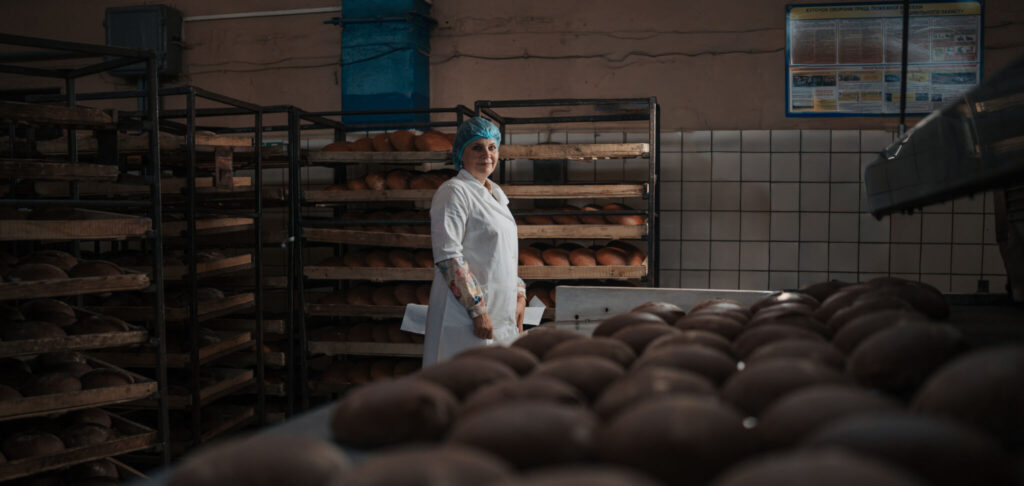
In 2025, Vira visited Chernihiv Bakery Number 2, where she met people who cared for the flour and ovens even while bombs were falling.
1.
It was maybe the seventh or eighth day of the full-scale war and the third day of bombings, both at night and during the day. Chernihiv translator Viktoriia doesn’t question where this bread came from – or its carefully sliced half. She breaks the white loaf in two: one piece for her older, ten-year-old son, the other for her eight-year-old. She shares the rest with us.
Volodia, a school music teacher and close family friend who brought these half-loaves, refuses to take any himself – he still has the other half for his family. Last time he brought smoked salmon, some chocolate candies, and a package of very expensive Italian pasta. This showed that the store shelves were empty; only special treats remained, which could now be bought at any price. Soon, there would be nowhere left to spend money. And now he had brought bread that was still warm.
It was so warm that we wondered where it came from. Volodia explained it was fresh from the factory. Water shortages had already started in Chernihiv; electricity was only on for a few hours, but the gas was still working as usual.
“From the factory? Are they still baking bread here? Then everything will definitely be all right,” said Viktoriia and took a bite of her crust.
Warm bread amid constant fear and the sound of planes felt out of place. The Russian army was about to surround Chernihiv, and here we were, right in the middle, sharing bread fresh from an oven that was still working.


“I wanted to say I don’t really like white bread – I prefer dark bread – but during the war, that felt wrong, so politely I took a bite, though I only swallowed the sweet tea,” said Viktoriia. “Then suddenly, I realized this was the best bread I had ever tasted. Looking at the white crust, I wondered why Grandma always baked only white bread.”
About ten days later, the Russians fired a Grad rocket at the bread line right near Viktoriia’s house. Twenty people waiting for bread were killed. There were about a hundred people in the line.
2.
“In my mind, baking bread looks like this,” I laugh, feeling shy. “A small bowl, Grandma covers the dough with a towel, it rests, then she puts it in the oven and takes out the finished loaf. But today, it’s clearly not like that. Can you explain how it really happens?”
“You’re partly right,” says Olha Zaika, director of Chernihiv Bakery Number 2. She speaks of bread as if it were a person – no, a child – with pride. She still remembers her first shift: at a bakery in Poltava Oblast, wearing gloves, she caught hot loaves and stacked them in boxes.

We’ve just broken open a raisin loaf that burns your fingers.
“Today, there are home mini-ovens: you pour in the ingredients and wait for the bread to be ready,” says Olha. “But here, everything is more complicated. We still work with technologies that are hundreds of years old. It’s just on a different scale.”
So, we talk about bread as if it were a living thing. It all starts with the raw ingredients: flour, salt, sugar, eggs, yeast, oil, and so on. In the sourdough section – the first stage of birth: flour meets water and sourdough starter. Then comes the kneading – the dough is twisted by large metal machines, like giant hands. Next comes the poetry of the process: the divider measures out pieces, the rounder forms balls, and the pre-proofing box gives the bread a few minutes of quiet. The sheeter rolls the dough into thin sheets and twists them into rolls – this is how a loaf is born.
The loaves rise in the proofing chamber, gaining weight and a firm shape. When they’re ready, they’re moved to a massive, tunnel-like oven. You could walk along it for minutes, peering into the small windows. At first, the loaves are as white as milk. Later, they turn yellow, like chicks. In the end, they come out golden and crispy, exactly the kind we’re used to.
3.
Now they always have enough to last a month-long siege.
Back then, the war caught them by surprise, as it did many others. They didn’t keep large stocks of flour and raw materials, because that’s their usual rhythm: every day the trucks deliver, and the ovens consume. That February brought a harsh realization: if supplies stopped, they could bake bread at their usual average daily volume for two weeks, but what then? Some ingredients came from parts of Chernihiv Oblast that were now rapidly being occupied.
Olha knew people would need bread. Bread, salt, water, and you can survive. So, the ovens had to keep working, and someone wearing gloves had to catch the hot loaves at the end. The military came first that day and asked for a few days’ supply. We gave it to them. Soon after, the head doctor of the Chernihiv maternity hospital came by herself. She had many families in her shelter, full of women and children.
“Olena Mykhailivna,” the doctor said, “can we have some fresh bread today… I came myself; we’re not waiting for someone to bring it to us.”
As the doctor’s car sped down the empty road, Olha realized that this doctor was certainly not the last – dozens more would arrive soon. If only dozens.
4.
At first, the bakery was operating on all three lines. There was electricity, there was water, the explosions were distant, the shock of the first days was still strong, and everyone was working with more dedication than ever. But the days passed, and Russian planes began arriving more and more frequently, dropping massive bombs from their bomb racks. Dozens of other shells, whose names no one knew at the time, fell on the city.
First, the Russians hit the bakery’s administrative building. After that, many workers took off their gloves and left the city. Olha understood everyone. She kept saying, “Your life comes first.” But a handful of people stayed. Some didn’t want to leave, and others couldn’t. About thirty workers, three times fewer than usual.
Olha kept reminding everyone about the shelter under the pastry section. But those who stayed kept working. “Olena Mykhailivna, do you understand how vital bread is?” a worker asked her one day. Olha froze. “I understand,” she replied. With bread, every minute counts.
During the siege of the city, the factory didn’t bake bread for just one day. It was the day before that Volodia brought us that priceless half-loaf. Supplies were dwindling, and delivering them was becoming more dangerous. People had gone into hiding; the market stalls were empty. There was enough bread, but no one came to get it.
But by the next day, everything was up and running again. Volunteers arrived, and utility services brought water, which had to be pumped up to the third floor through a hose from a large tank.
Meanwhile, bread was delivered to stores, but people could also come to the bakery. Sellers waited for the bread while holding other goods – milk, candy, and sausage. A real “hand-to-hand” market appeared. People traded, swapped, and bargained at the loading dock.
In March, Chernihiv became a city of cyclists – gasoline was hard to find. And there were even horses on the streets. One community near Chernihiv, on the front lines, came to get bread by horse-drawn cart. Just like, probably, in 1896, when a mechanized bakery opened in the city, starting the bread factory’s history.
When the Russians were driven out of the Chernihiv Oblast, the bakery ovens began to fire up one after another. And normality returned when someone finally said aloud: “So, when do we start thinking about Easter Bread?” Usually, bakers start preparing for it in January.

5.
Everything is busy here. You have to shout to be heard. You get lost in the hallways and, for a moment, feel like the warm bread being made. Today, everything is working as usual. Bread moves through three hot tunnels, slowly turning golden. A white loaf is the fastest and easiest to bake, so in wartime, it really is the best bread.
When the director first saw the announcement about grants from East Europe Foundation, she hesitated: they hadn’t done anything like this before, and the competition was only for a few regions. Olha wasn’t sure if they could get it. But she still called the economists to a meeting. They decided to buy an electric oven, which uses much less energy than their usual gas ovens. And, unlike gas ovens, it doesn’t release CO₂.
“The goal was to replace their oven with a more energy-efficient, modernized, new one,” says Oksana Medvedenko, Grants and Contracts Manager at East Europe Foundation. “When we announced the call for proposals for the Power Up program, we understood that businesses have a different experience working with grants than civil society organizations. But the Chernihiv Bread Factory №2 was very proactive and motivated, so it started and finished first.”
In the end, the bakery got its oven.
“Business is still business; it’s important for it to sustain itself through investments. But by supporting the business, we also indirectly support the community. Especially if it’s a municipal enterprise. Plus, if they grow their business, it provides jobs for people in that community,” says Program Manager Yuliia Smahliukova.

Olha loves trying new things. It’s important to her not just to bake bread but also to find new ways to deliver it. They created a system: baking and delivering bread in paper bags just as people come home from work. They use the new electric oven for this too. It helps them work faster: they put one batch in the rotary oven and use the new one to bake the evening delivery batch more quickly.
“Because the tastiest bread is fresh, right?” Olha states rather than asks.
This story is a part of the book “Friday Letter.” You can read it in English at the link.